What Role Did the Art of Sculpting Play in Romanesque Church?
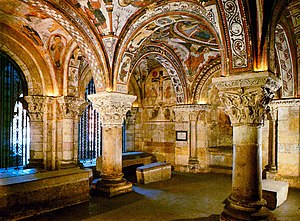
Romanesque fine art is the fine art of Europe from approximately grand Advertisement to the rise of the Gothic mode in the 12th century, or later depending on region. The preceding menstruum is known as the Pre-Romanesque period. The term was invented by 19th-century fine art historians, specially for Romanesque architecture, which retained many basic features of Roman architectural fashion – most notably round-headed arches, but as well butt vaults, apses, and acanthus-leaf decoration – but had also developed many very different characteristics. In Southern France, Spain, and Italy there was an architectural continuity with the Late Antique, only the Romanesque manner was the beginning way to spread beyond the whole of Catholic Europe, from Sicily to Scandinavia. Romanesque art was besides greatly influenced by Byzantine art, especially in painting, and past the anti-classical free energy of the decoration of the Insular fine art of the British Isles. From these elements was forged a highly innovative and coherent manner.
Characteristics [edit]
Outside Romanesque architecture, the art of the period was characterised past a vigorous fashion in both sculpture and painting. The latter continued to follow substantially Byzantine iconographic models for the most mutual subjects in churches, which remained Christ in Majesty, the Last Judgment, and scenes from the Life of Christ. In illuminated manuscripts more than originality is seen, as new scenes needed to be depicted. The most lavishly decorated manuscripts of this period were bibles and psalters. The same originality applied to the capitals of columns: often carved with consummate scenes with several figures. The large wooden crucifix was a German innovation at the very start of the period, as were free-standing statues of the enthroned Madonna. High relief was the dominant sculptural manner of the period.
Colours were very striking, and by and large master. In the 21st century: these colours can only be seen in their original effulgence in stained glass, and a few well-preserved manuscripts. Stained drinking glass became widely used, although survivals are sadly few. In an invention of the period, the tympanums of important church portals were carved with monumental schemes, often Christ in Majesty or the Terminal Judgement, simply treated with more freedom than painted versions, as there were no equivalent Byzantine models.
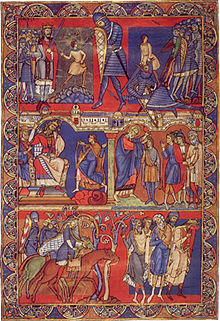
Compositions usually had little depth and needed to be flexible to be squeezed into the shapes of historiated initials, cavalcade capitals, and church building tympanums; the tension betwixt a tightly enclosing frame, from which the limerick sometimes escapes, is a recurrent theme in Romanesque art. Figures oft varied in size in relation to their importance. Landscape backgrounds, if attempted at all, were closer to abstract decorations than realism – every bit in the trees in the "Morgan Leaf". Portraiture hardly existed.
Groundwork [edit]
During this period Europe grew steadily more prosperous, and fine art of the highest quality was no longer confined, as it largely was in the Carolingian and Ottonian periods, to the majestic court and a small circle of monasteries. Monasteries continued to be extremely important, especially those of the expansionist new orders of the period, the Cistercian, Cluniac, and Carthusian, which spread beyond Europe. But urban center churches, those on pilgrimage routes, and many churches in small-scale towns and villages were elaborately decorated to a very high standard – these are often the structures to have survived, when cathedrals and urban center churches take been rebuilt. No Romanesque royal palace has really survived.
The lay artist was becoming a valued effigy – Nicholas of Verdun seems to accept been known across the continent. Almost masons and goldsmiths were at present lay, and lay painters such equally Chief Hugo seem to take been in the majority, at least of those doing the best work, by the end of the period. The iconography of their church building work was no doubt arrived at in consultation with clerical advisors.
Sculpture [edit]
Metalwork, enamels, and ivories [edit]

Precious objects in these media had a very loftier status in the period, probably much more than so than paintings – the names of more makers of these objects are known than those of contemporary painters, illuminators or architect-masons. Metalwork, including decoration in enamel, became very sophisticated. Many spectacular shrines fabricated to hold relics take survived, of which the best known is the Shrine of the Iii Kings at Cologne Cathedral by Nicholas of Verdun and others (c. 1180–1225). The Stavelot Triptych and Reliquary of St. Maurus are other examples of Mosan enamelwork. Big reliquaries and altar frontals were built around a wooden frame, but smaller caskets were all metal and enamel. A few secular pieces, such every bit mirror cases, jewellery and clasps have survived, but these no doubt under-represent the amount of fine metalwork owned past the nobility.
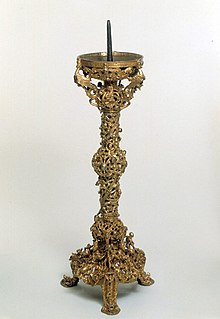
The bronze Gloucester candlestick and the brass font of 1108–1117 now in Liège are superb examples, very unlike in manner, of metal casting. The former is highly intricate and energetic, drawing on manuscript painting, while the font shows the Mosan style at its nearly classical and majestic. The bronze doors, a triumphal column and other fittings at Hildesheim Cathedral, the Gniezno Doors, and the doors of the Basilica di San Zeno in Verona are other substantial survivals. The aquamanile, a container for h2o to wash with, appears to have been introduced to Europe in the 11th century. Artisans often gave the pieces fantastic zoomorphic forms; surviving examples are mostly in brass. Many wax impressions from impressive seals survive on charters and documents, although Romanesque coins are mostly not of great aesthetic interest.
The Cloisters Cross is an unusually large ivory crucifix, with complex etching including many figures of prophets and others, which has been attributed to ane of the relatively few artists whose name is known, Main Hugo, who also illuminated manuscripts. Like many pieces it was originally partly coloured. The Lewis chessmen are well-preserved examples of small ivories, of which many pieces or fragments remain from croziers, plaques, pectoral crosses and similar objects.
Architectural sculpture [edit]
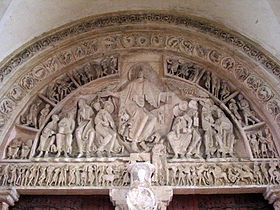
With the fall of the Western Roman Empire, the tradition of carving large works in stone and sculpting figures in bronze died out, as it effectively did (for religious reasons) in the Byzantine (Eastern Roman) world. Some life-size sculpture was apparently done in stucco or plaster, simply surviving examples are understandably rare.[one] The best-known surviving large sculptural work of Proto-Romanesque Europe is the life-size wooden Crucifix commissioned past Archbishop Gero of Cologne in nearly 960–965, plain the prototype of what became a popular form. These were afterward prepare on a axle below the chancel arch, known in English every bit a rood, from the twelfth century accompanied by figures of the Virgin Mary and John the Evangelist to the sides.[two] During the 11th and twelfth centuries, figurative sculpture strongly revived, and architectural reliefs are a hallmark of the later on Romanesque menstruum.
Sources and style [edit]
Figurative sculpture was based on ii other sources in particular, manuscript illumination and small-scale sculpture in ivory and metal. The extensive friezes sculpted on Armenian and Syriac churches take been proposed as another likely influence.[3] These sources together produced a distinct way which tin can exist recognised across Europe, although the most spectacular sculptural projects are full-bodied in S-Western France, Northern Kingdom of spain and Italy.
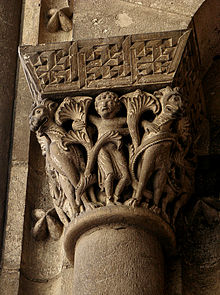
Images that occurred in metalwork were oft embossed. The resultant surface had ii main planes and details that were usually incised. This treatment was adapted to stone carving and is seen particularly in the tympanum above the portal, where the imagery of Christ in Majesty with the symbols of the Four Evangelists is fatigued directly from the gilt covers of medieval Gospel Books. This style of doorway occurs in many places and continued into the Gothic catamenia. A rare survival in England is that of the "Prior's Door" at Ely Cathedral. In South-Western French republic, many have survived, with impressive examples at Saint-Pierre, Moissac, Souillac,[four] and La Madeleine, Vézelay – all daughter houses of Cluny, with extensive other sculpture remaining in cloisters and other buildings. Nearby, Autun Cathedral has a Concluding Judgement of great rarity in that it has uniquely been signed by its creator, Giselbertus.[v] [6]
A characteristic of the figures in manuscript illumination is that they often occupy confined spaces and are contorted to fit. The custom of artists to make the figure fit the available space lent itself to a facility in designing figures to ornamentation door posts and lintels and other such architectural surfaces. The robes of painted figures were commonly treated in a flat and decorative way that bore lilliputian resemblance to the weight and fall of actual cloth. This feature was also adjusted for sculpture. Among the many examples that be, one of the finest is the effigy of the Prophet Jeremiah from the pillar of the portal of the Abbey of Saint-Pierre, Moissac, France, from about 1130.[6]
One of the most pregnant motifs of Romanesque blueprint, occurring in both figurative and not-figurative sculpture is the spiral. One of the sources may be Ionic capitals. Scrolling vines were a common motif of both Byzantine and Roman blueprint, and may be seen in mosaic on the vaults of the quaternary century Church of Santa Costanza, Rome. Manuscripts and architectural carvings of the 12th century have very like scrolling vine motifs.

This capital of Christ washing the anxiety of his Apostles has strong narrative qualities in the interaction of the figures.
Another source of the spiral is clearly the illuminated manuscripts of the 7th to 9th centuries, peculiarly Irish manuscripts such every bit the St. Gall Gospel Book, spread into Europe by the Hiberno-Scottish mission. In these illuminations the use of the spiral has nothing to do with vines or other plant forms. The motif is abstract and mathematical. The style was then picked up in Carolingian art and given a more botanical character. It is in an adaptation of this form that the spiral occurs in the draperies of both sculpture and stained drinking glass windows. Of all the many examples that occur on Romanesque portals, one of the most outstanding is that of the central figure of Christ at La Madeleine, Vezelay.[half-dozen]
Some other influence from Insular art are engaged and entwined animals, often used to superb issue in capitals (as at Silos) and sometimes on a column itself (as at Moissac). Much of the handling of paired, confronted and entwined animals in Romanesque decoration has similar Insular origins, as exercise animals whose bodies tail into purely decorative shapes. (Despite the adoption of Hiberno-Saxon traditions into Romanesque styles in England and on the continent, the influence was primarily 1-way. Irish fine art during this menstruation remained isolated, developing a unique constructing of native Irish and Viking styles which would be slowly extinguished and replaced by mainstream Romanesque style in the early 13th century post-obit the Anglo-Norman invasion of Ireland.[vii])

Subject thing [edit]
Most Romanesque sculpture is pictorial and biblical in subject. A great variety of themes are plant on capitals and include scenes of Creation and the Fall of Man, episodes from the life of Christ and those Old Testament scenes which prefigure his Death and Resurrection, such as Jonah and the Whale and Daniel in the lions' den. Many Nascence scenes occur, the theme of the Three Kings being particularly popular. The cloisters of Santo Domingo de Silos Abbey in Northern Spain, and Moissac are fine examples surviving complete, as are the relief sculptures on the many Tournai fonts found in churches in southern England, France and Belgium.
A characteristic of some Romanesque churches is the extensive sculptural scheme which covers the area surrounding the portal or, in some case, much of the facade. Angouleme Cathedral in French republic has a highly elaborate scheme of sculpture set within the wide niches created past the arcading of the facade. In the Spanish region of Catalonia, an elaborate pictorial scheme in low relief surrounds the door of the church of Santa Maria at Ripoll.[6]
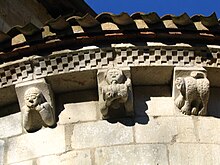
Around the upper wall of the chancel at the Abbaye d'Arthous, Landes, France, are small figures depicting lust, intemperance and a Barbary ape, symbol of human depravity.
The purpose of the sculptural schemes was to convey a message that the Christian believer should recognize wrongdoing, apologize and be redeemed. The Last Judgement reminds the believer to apologize. The carved or painted Crucifix, displayed prominently within the church, reminds the sinner of redemption.
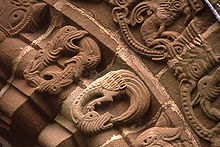
Often the sculpture is alarming in form and in subject matter. These works are found on capitals, corbels and bosses, or entwined in the leafage on door mouldings. They represent forms that are not easily recognizable today. Common motifs include Sheela na Gig, fearsome demons, ouroboros or dragons swallowing their tails, and many other mythical creatures with obscure meaning. Spirals and paired motifs originally had special significance in oral tradition that has been lost or rejected by modern scholars.
The 7 Mortiferous Sins including lust, gluttony and avarice are likewise ofttimes represented. The appearance of many figures with oversized genitals can be equated with carnal sin, and and so can the numerous figures shown with protruding tongues, which are a feature of the doorway of Lincoln Cathedral. Pulling one'southward beard was a symbol of masturbation, and pulling 1's mouth wide open was also a sign of lewdness. A common theme found on capitals of this period is a tongue poker or beard stroker beingness beaten by his wife or seized by demons. Demons fighting over the soul of a wrongdoer such as a miser is another popular subject field.[viii]
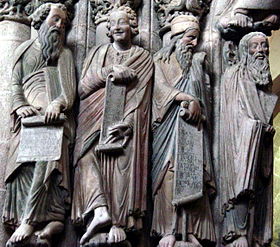
Pórtico da Gloria, Santiago Cathedral. The colouring in one case common to much Romanesque sculpture has been preserved.
Late Romanesque sculpture [edit]
Gothic architecture is commonly considered to begin with the design of the choir at the Abbey of Saint-Denis, north of Paris, past the Abbot Suger, consecrated 1144. The showtime of Gothic sculpture is normally dated a little later, with the carving of the figures effectually the Royal Portal at Chartres Cathedral, France, 1150–1155. The way of sculpture spread rapidly from Chartres, overtaking the new Gothic compages. In fact, many churches of the late Romanesque period mail-appointment the building at Saint-Denis. The sculptural style based more upon ascertainment and naturalism than on formalised design adult speedily. It is thought that one reason for the rapid development of naturalistic form was a growing awareness of Classical remains in places where they were virtually numerous and a deliberate fake of their way. The consequence is that there are doorways which are Romanesque in class, and nonetheless prove a naturalism associated with Early Gothic sculpture.[6]
One of these is the Pórtico da Gloria dating from 1180, at Santiago de Compostela. This portal is internal and is specially well preserved, fifty-fifty retaining colour on the figures and indicating the gaudy advent of much architectural decoration which is now perceived as monochrome. Around the doorway are figures who are integrated with the colonnettes that make the mouldings of the doors. They are iii-dimensional, only slightly flattened. They are highly individualised, not only in advent but as well expression and behave quite stiff resemblance to those effectually the north porch of the Abbey of St. Denis, dating from 1170. Beneath the tympanum in that location is a realistically carved row of figures playing a range of different and easily identifiable musical instruments.
Painting [edit]

Manuscript illumination [edit]
A number of regional schools converged in the early Romanesque illuminated manuscript: the "Channel school" of England and Northern French republic was heavily influenced by late Anglo-Saxon art, whereas in Southern France the mode depended more on Iberian influence, and in Federal republic of germany and the Low Countries, Ottonian styles connected to develop, and also, forth with Byzantine styles, influenced Italia. Past the twelfth century there had been reciprocal influences betwixt all these, although naturally regional distinctiveness remained.
The typical foci of Romanesque illumination were the Bible, where each volume could be prefaced by a large historiated initial, and the Psalter, where major initials were similarly illuminated. In both cases more lavish examples might have cycles of scenes in fully illuminated pages, sometimes with several scenes per folio, in compartments. The Bibles in particular often had a, and might be spring into more than ane volume. Examples include the St. Albans Psalter, Hunterian Psalter, Winchester Bible (the "Morgan Leaf" shown in a higher place), Fécamp Bible, Stavelot Bible, and Parc Abbey Bible. By the end of the period lay commercial workshops of artists and scribes were becoming significant, and illumination, and books more often than not, became more widely available to both laity and clergy.
Wall painting [edit]
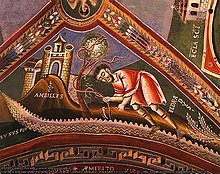

The large wall surfaces and apparently, curving vaults of the Romanesque flow lent themselves to landscape decoration. Unfortunately, many of these early wall paintings have been destroyed by damp or the walls have been replastered and painted over. In England, France and the netherlands such pictures were systematically destroyed or whitewashed in bouts of Reformation iconoclasm. In Denmark, in Sweden, and elsewhere many have since been restored. In Catalonia (Spain), there was a campaign to save such murals in the early 20th century (every bit of 1907) by removing them and transferring them to safekeeping in Barcelona, resulting in the spectacular drove at the National Art Museum of Catalonia. In other countries they take suffered from war, neglect and changing fashion.
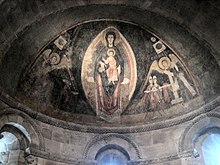
A classic scheme for the full painted decoration of a church building, derived from earlier examples oftentimes in mosaic, had, as its focal point in the semi-dome of the apse, Christ in Majesty or Christ the Redeemer enthroned within a mandorla and framed by the four winged beasts, symbols of the Four Evangelists, comparing directly with examples from the aureate covers or the illuminations of Gospel Books of the flow. If the Virgin Mary was the dedicatee of the church, she might replace Christ hither. On the apse walls below would be saints and apostles, perhaps including narrative scenes, for example of the saint to whom the church was dedicated. On the sanctuary arch were figures of apostles, prophets or the twenty-four "elders of the Apocalypse", looking in towards a bosom of Christ, or his symbol the Lamb, at the height of the arch. The due north wall of the nave would incorporate narrative scenes from the Sometime Testament, and the south wall from the New Testament. On the rear west wall would exist a Last Judgement, with an enthroned and judging Christ at the top.[9]
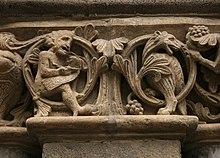
1 of the most intact schemes to exist is that at Saint-Savin-sur-Gartempe in France. The long butt vault of the nave provides an first-class surface for fresco, and is decorated with scenes of the Erstwhile Attestation, showing the Creation, the Fall of Man and other stories including a lively depiction of Noah's Ark complete with a fearsome figurehead and numerous windows through which can exist seen Noah and his family on the upper deck, birds on the heart deck, while on the lower are the pairs of animals. Another scene shows with great vigour the swamping of Pharaoh'south army by the Carmine Sea. The scheme extends to other parts of the church building, with the martyrdom of the local saints shown in the crypt, and Apocalypse in the narthex and Christ in Majesty. The range of colours employed is express to light blue-dark-green, yellow ochre, cerise dark-brown and black. Like paintings exist in Serbia, Spain, Deutschland, Italy and elsewhere in France.[x]
The now-dispersed paintings from Arlanza in the Province of Burgos, Espana, though from a monastery, are secular in subject-matter, showing huge and vigorous mythical beasts above a frieze in black and white with other creatures. They requite a rare thought of what busy Romanesque palaces would take contained.
Other visual arts [edit]
Embroidery [edit]
Romanesque embroidery is best known from the Bayeux Tapestry, only many more than closely worked pieces of Opus Anglicanum ("English language work" – considered the finest in the Westward) and other styles have survived, mostly as church vestments.
Stained drinking glass [edit]
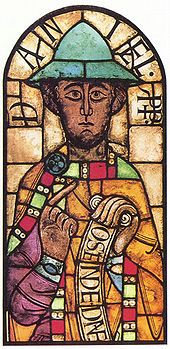
The oldest-known fragments of medieval pictorial stained drinking glass appear to engagement from the 10th century. The earliest intact figures are five prophet windows at Augsburg, dating from the belatedly 11th century. The figures, though stiff and formalised, demonstrate considerable proficiency in design, both pictorially and in the functional employ of the glass, indicating that their maker was well accustomed to the medium. At Le Mans, Canterbury and Chartres Cathedrals, and Saint-Denis, a number of panels of the twelfth century have survived. At Canterbury these include a figure of Adam excavation, and another of his son Seth from a series of Ancestors of Christ. Adam represents a highly naturalistic and lively portrayal, while in the figure of Seth, the robes take been used to great decorative effect, similar to the best rock carving of the menses. Glass craftsmen were slower than architects to change their style, and much glass from at to the lowest degree the first part of the 13th century can exist considered equally essentially Romanesque. Particularly fine are large figures of 1200 from Strasbourg Cathedral (some at present removed to the museum) and of about 1220 from Saint Kunibert's Church in Cologne.
Near of the magnificent stained glass of France, including the famous windows of Chartres, date from the 13th century. Far fewer large windows remain intact from the 12th century. 1 such is the Crucifixion of Poitiers, a remarkable composition which rises through three stages, the lowest with a quatrefoil depicting the Martyrdom of St Peter, the largest central stage dominated by the crucifixion and the upper phase showing the Ascension of Christ in a mandorla. The figure of the crucified Christ is already showing the Gothic curve. The window is described by George Seddon as being of "unforgettable beauty".[11] Many detached fragments are in museums, and a window at Twycross Church in England is fabricated up of important French panels rescued from the French Revolution.[12] Glass was both expensive and adequately flexible (in that information technology could exist added to or re-bundled) and seems to have been frequently re-used when churches were rebuilt in the Gothic style – the earliest datable English glass, a panel in York Minster from a Tree of Jesse probably of before 1154, has been recycled in this way.
See also [edit]
- Romanesque compages
- Listing of Romanesque artists
- Spanish Romanesque
Notes [edit]
- ^ Some (probably) 9th century near life-size stucco figures were discovered behind a wall in Santa Maria in Valle, Cividale del Friuli in Northern Italian republic relatively recently. Atroshenko and Collins p. 142
- ^ G Schiller, Iconography of Christian Art, Vol. II, 1972 (English language trans from High german), Lund Humphries, London, pp. 140–142 for early crosses, p. 145 for roods, ISBN 0-85331-324-5
- ^ V. I. Atroshenko and Judith Collins, The Origins of the Romanesque, p. 144–150, Lund Humphries, London, 1985, ISBN 0-85331-487-X
- ^ Howe, Jeffery. "Romanesque Architecture (slides)". A digital archive of compages. Boston College. Retrieved 2007-09-28 .
- ^ Helen Gardner, Art through the Ages.
- ^ a b c d due east Rene Hyughe, Larousse Encyclopedia of Byzantine and Medieval Art
- ^ Roger A. Stalley, "Irish Art in the Romanesque and Gothic Periods". In Treasures of Irish Art 1500 B.C. to 1500 A.D., New York: Metropolitan Museum of Art/Alfred A. Knopf, 1977.
- ^ "Satan in the Groin". beyond-the-pale. Retrieved 2007-09-28 .
- ^ James Hall, A History of Ideas and Images in Italian Art, p154, 1983, John Murray, London, ISBN 0-7195-3971-four
- ^ Rolf Toman, Romanesque, Könemann, (1997), ISBN 3-89508-447-6
- ^ George Seddon in Lee, Seddon and Stephens, Stained Drinking glass
- ^ Church website Archived 2008-07-08 at the Wayback Machine
References [edit]
- Legner, Anton (ed). Ornamenta Ecclesiae, Kunst und Künstler der Romanik. Catalogue of an exhibition in the Schnütgen Museum, Köln, 1985. three vols.
- Conrad Rudolph, ed., A Companion to Medieval Art: Romanesque and Gothic in Northern Europe, 2nd ed. (2016)
External links [edit]
- Metropolitan Museum Timeline Essay
- crsbi.ac.uk (Electronic archive of medieval British and Irish Romanesque stone sculpture)
- Corpus of Romanesque Sculpture in Britain and Ireland
- Romanes.com Romanesque Fine art in France
- Círculo Románico: Visigothic, Mozarabic and Romanesque art's in all Europe
- Romanesque Sculpture group on Flickr
Source: https://en.wikipedia.org/wiki/Romanesque_art
0 Response to "What Role Did the Art of Sculpting Play in Romanesque Church?"
Postar um comentário